
As part of the New Jersey Common Core Standards for 6th-grade mathematics, surface area presents a fresh challenge for students. Clear, structured instruction can help remove confusion and build confidence.
Drawing Connections
Begin by making surface area meaningful. Give students a chance to share how they encounter it in their daily lives.
Here are some conversation starters:
- Have you ever wrapped a present? What strategies do you use to make sure you have the right amount of paper?
- Have you ever painted a room? How did you figure out how much paint you would need?
- Have you ever decorated a cake? How did you know how much icing to buy to cover the cake completely?
By connecting surface area to real experiences, students start with something familiar before moving into the calculations.
Introducing Nets
Most students are already comfortable finding the area of flat, 2D shapes. Nets are the perfect bridge from 2D to 3D.

- Give students flat, unconstructed net printouts (focus on rectangular prisms, triangular prisms, square pyramids, and triangular pyramids).
- Have them cut, fold, and tape the nets into 3D shapes.
- Provide three different colored highlighters. Model how to:
- Outline edges in one color
- Mark vertices in another
- Shade faces in the final color
This helps students identify the characteristics of each polyhedron and make the connection between the flat net and the 3D shape.
Using Nets to Find Areas
Once students can connect a net to its 3D shape, it’s time to calculate surface area.

- Give each student a net and highlighters again (or any writing utensils with various colors).
- Have them outline each individual 2D shape within the net and record its area.
- Ask: Do these single numbers give us the total surface area?
- Guide them to realize that adding the areas of all faces gives the surface area of the shape.
Put It Into Practice!


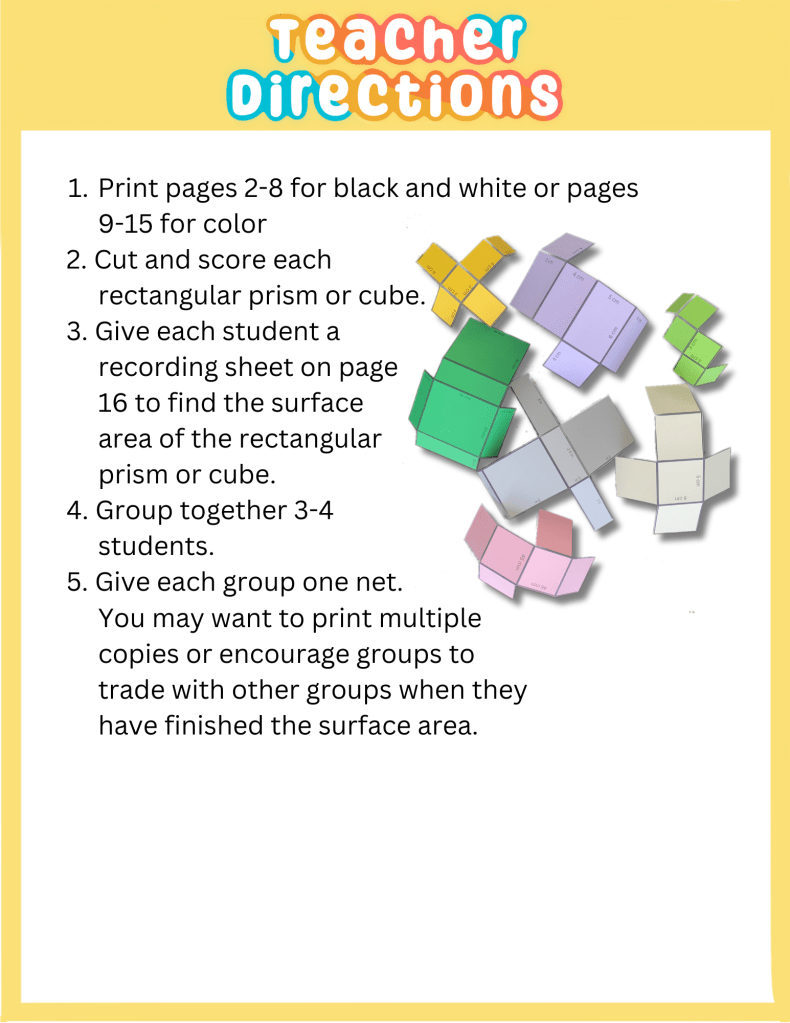
Turn practice into an active classroom challenge:
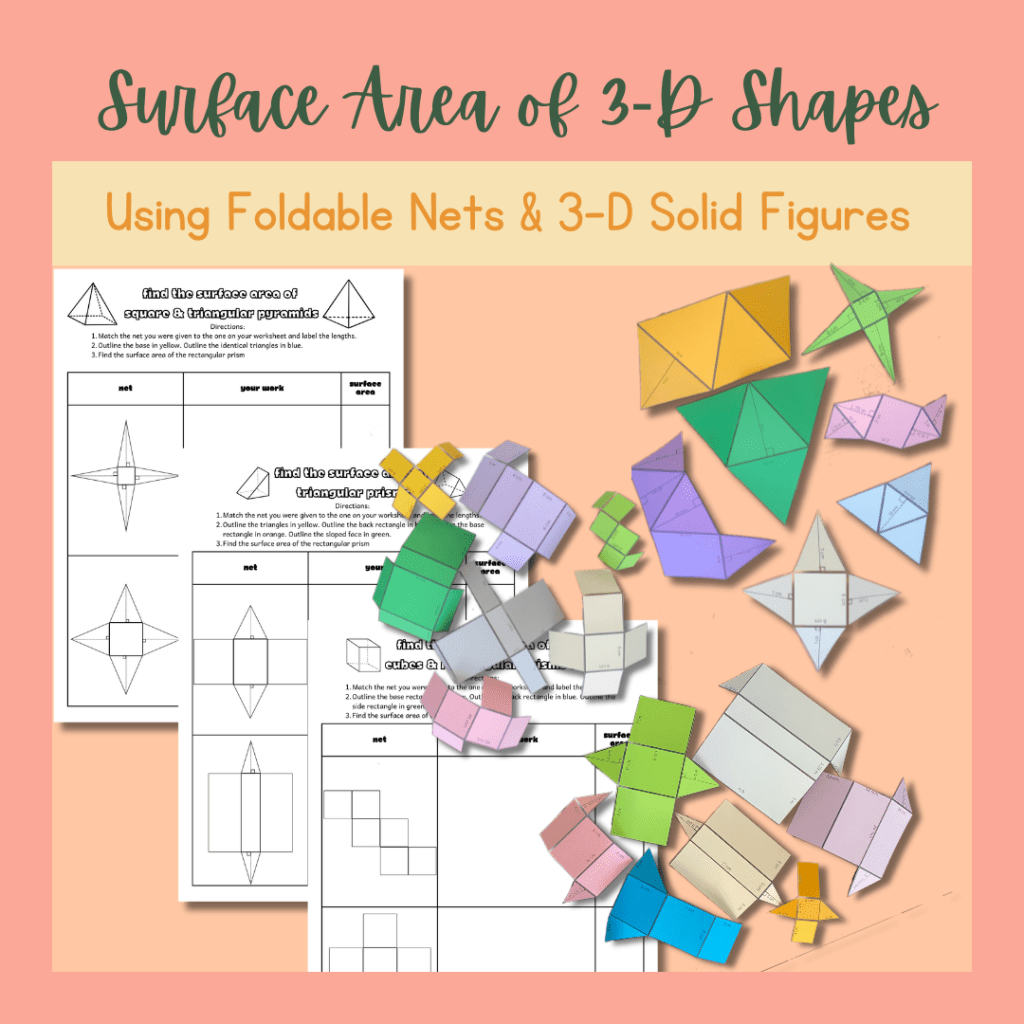
- Cut each net from different colored paper, score the edges, and place them at stations around the room.
- Students move from station to station, calculating surface area.
- Once they check their answer with you, they move to the next shape
This creates a dynamic, self-paced learning environment where:
- Confident students can zip through shapes.
- Peer learning happens naturally.
- You can work one-on-one with students who need extra guidance.
Check out my bundle on Teachers Pay Teachers for this fantastic surface area resource!
Why This Works
This approach combines hands-on learning, visual connections, and movement. Students don’t just memorize formulas—they see, touch, and build the relationship between nets and surface area. The result? Stronger understanding, better retention, and an engaged classroom.




 Kait's Kreations
Leave a comment